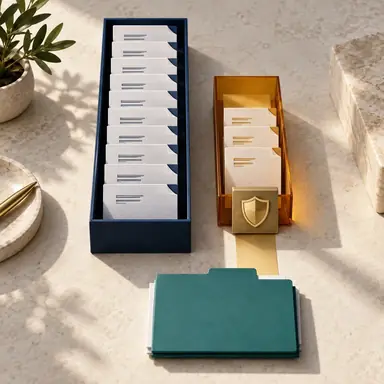
Example result illustrating this prompt's visual direction. Actual results may vary by model, reference image and settings.
 Requires Photo
  Automation Prompts
  Approval Notes to Automated Routing Prompts
 Returned Request Rework from Correction Notes
Transform correction notes into an approval rework loop that separates rejection, revision, and resubmission.
Prompt
Transform the uploaded reference photo into a clean, readable approval-routing visual. The intended source is a legible photo of approval correction notes showing return reasons, requester responsibilities, and resubmission rules. Use only legible information present in the photo or explicitly supplied alongside it. Preserve the source process meaning, role names, rule values, conditions, and relationships; replace the photographed paper or whiteboard presentation with a polished digital board. Do not reproduce desk clutter, handwriting defects, glare, or perspective distortion. Map return-for-correction as a distinct state from final rejection. Show the documented reason or missing evidence, the requester action, and the condition for resubmission. Preserve whether the corrected request returns to the original reviewer or restarts an earlier stage. Display which prior approvals remain valid only if the source specifies it. Keep the original request and revision identities distinct where described. Flag undefined resubmission destinations or approval retention rules as Needs clarification; do not invent retry limits or assume a corrected request is approved. Compose a compact loop-shaped correction board with reviewer, returned request, revision evidence, and resubmission cards; rejection sits outside the loop. Use short English labels, high-contrast typography, orthogonal connectors, action cards for steps, and decision diamonds only for actual decisions. Use labels as well as color to distinguish states. Keep arrow direction unambiguous, avoid connector crossings, and fit the complete map inside the canvas without clipping. Include only labels needed to understand the workflow; do not add slogans, decorative captions, logos, or explanatory filler. For an unreadable or conflicting rule, preserve a visibly unresolved Needs clarification card at the affected point; never draw a falsely complete route beyond it. If the photo lacks enough legible content to identify the process, request a clearer source photo before creating the visual. Redact personal contact details, signatures, and account identifiers unless essential and explicitly requested; retain approver roles. Deliver one finished visual derived from the reference photo. This is a visual design for review: do not send notifications, grant approvals, change records, connect accounts, or claim an automation has been deployed.
Recommended:
ChatGPT


Upload your photo to the AI tool first, then use this prompt.
The prompt asks the model to preserve identity and key visual features.
How to use it
- Upload a legible photo of approval correction notes showing return reasons, requester responsibilities, and resubmission rules.
- Paste the prompt and provide any confirmed rule clarifications alongside the photo.
- Check the finished visual against the source and resolve all Needs clarification cards before using it to configure an automation.
Common failure fixes
- If return-for-correction is merged with rejection, restore separate states and destinations.
- If a revision bypasses required review, reconnect it to the resubmission stage documented in the source.
- If prior approvals are retained without evidence, mark their validity Needs clarification.