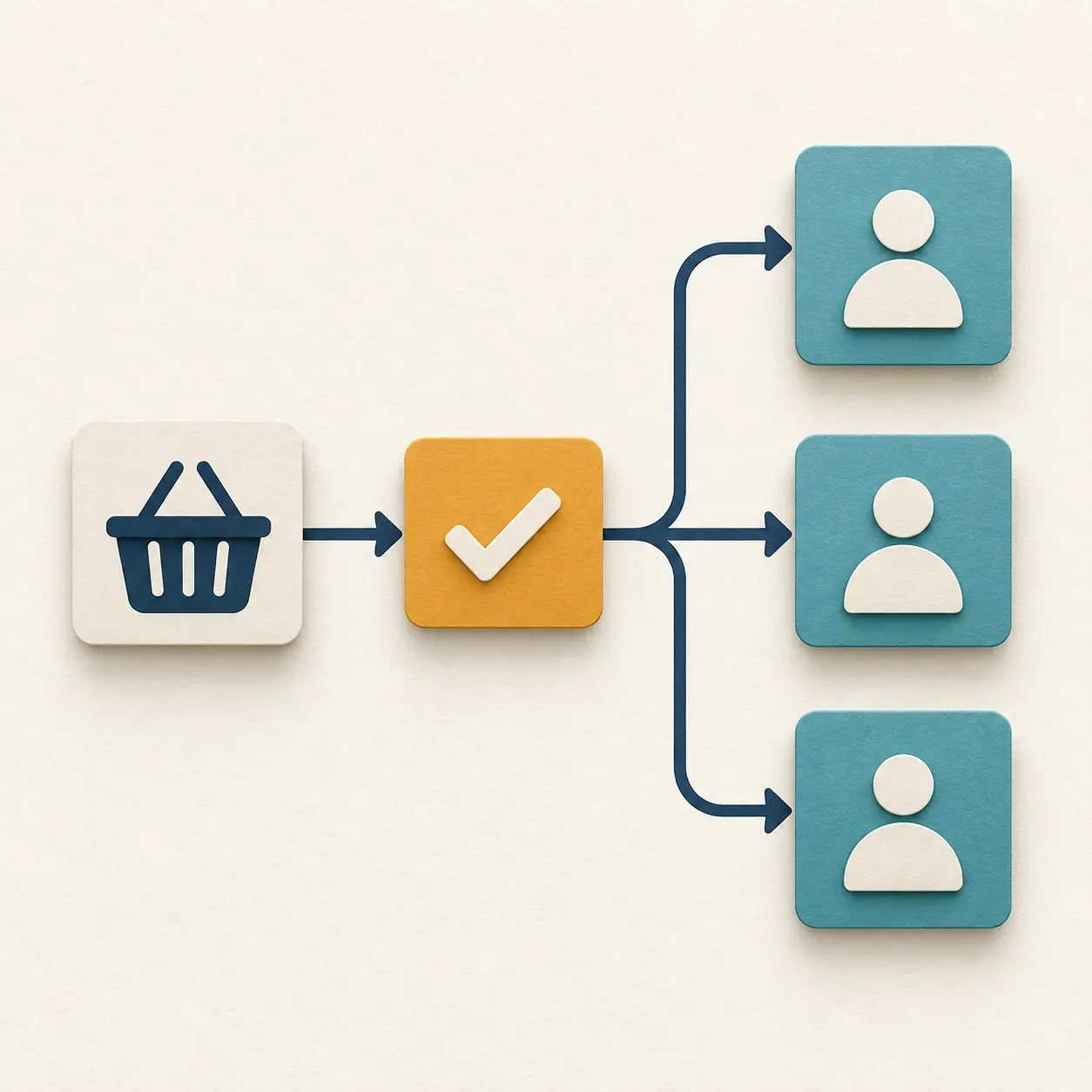
Example result illustrating this prompt's visual direction. Actual results may vary by model, reference image and settings.
 Requires Photo
  Automation Prompts
  Approval Notes to Automated Routing Prompts
 Purchase Approval Branches from Spending Threshold Notes
Transform photographed purchasing rules into an amount-based approval map with explicit threshold boundaries and exception handling.
Prompt
Transform the uploaded reference photo into a clean, readable approval-routing visual. The intended source is a legible photo of purchasing approval notes showing spend bands, currencies, approver roles, and any purchasing exceptions. Use only legible information present in the photo or explicitly supplied alongside it. Preserve the source process meaning, role names, rule values, conditions, and relationships; replace the photographed paper or whiteboard presentation with a polished digital board. Do not reproduce desk clutter, handwriting defects, glare, or perspective distortion. Translate each documented spend band into a separate decision branch. Preserve every amount, currency, comparison operator, and inclusive or exclusive boundary exactly. Identify overlapping bands, uncovered amounts, and missing currency rules as Needs clarification; do not resolve them by guessing. Connect each valid branch to its documented approver and show approved, rejected, and returned outcomes only where supported. Keep an exception route separate from normal purchasing. Do not infer currency conversion, tax treatment, or splitting purchases across thresholds. Compose a portrait purchasing workflow board with the intake card above a central amount decision and vertically staggered approver lanes. Use short English labels, high-contrast typography, orthogonal connectors, action cards for steps, and decision diamonds only for actual decisions. Use labels as well as color to distinguish states. Keep arrow direction unambiguous, avoid connector crossings, and fit the complete map inside the canvas without clipping. Include only labels needed to understand the workflow; do not add slogans, decorative captions, logos, or explanatory filler. For an unreadable or conflicting rule, preserve a visibly unresolved Needs clarification card at the affected point; never draw a falsely complete route beyond it. If the photo lacks enough legible content to identify the process, request a clearer source photo before creating the visual. Redact personal contact details, signatures, and account identifiers unless essential and explicitly requested; retain approver roles. Deliver one finished visual derived from the reference photo. This is a visual design for review: do not send notifications, grant approvals, change records, connect accounts, or claim an automation has been deployed.
Recommended:
ChatGPT


Upload your photo to the AI tool first, then use this prompt.
The prompt asks the model to preserve identity and key visual features.
How to use it
- Upload a legible photo of purchasing approval notes showing spend bands, currencies, approver roles, and any purchasing exceptions.
- Paste the prompt and provide any confirmed rule clarifications alongside the photo.
- Check the finished visual against the source and resolve all Needs clarification cards before using it to configure an automation.
Common failure fixes
- If a threshold boundary changes, restore the exact source comparison and flag any ambiguous boundary.
- If spend bands overlap or leave a gap, keep the affected path unresolved instead of inventing a rule.
- If approver lanes become tangled, stagger them vertically and keep each branch label adjacent to its connector.